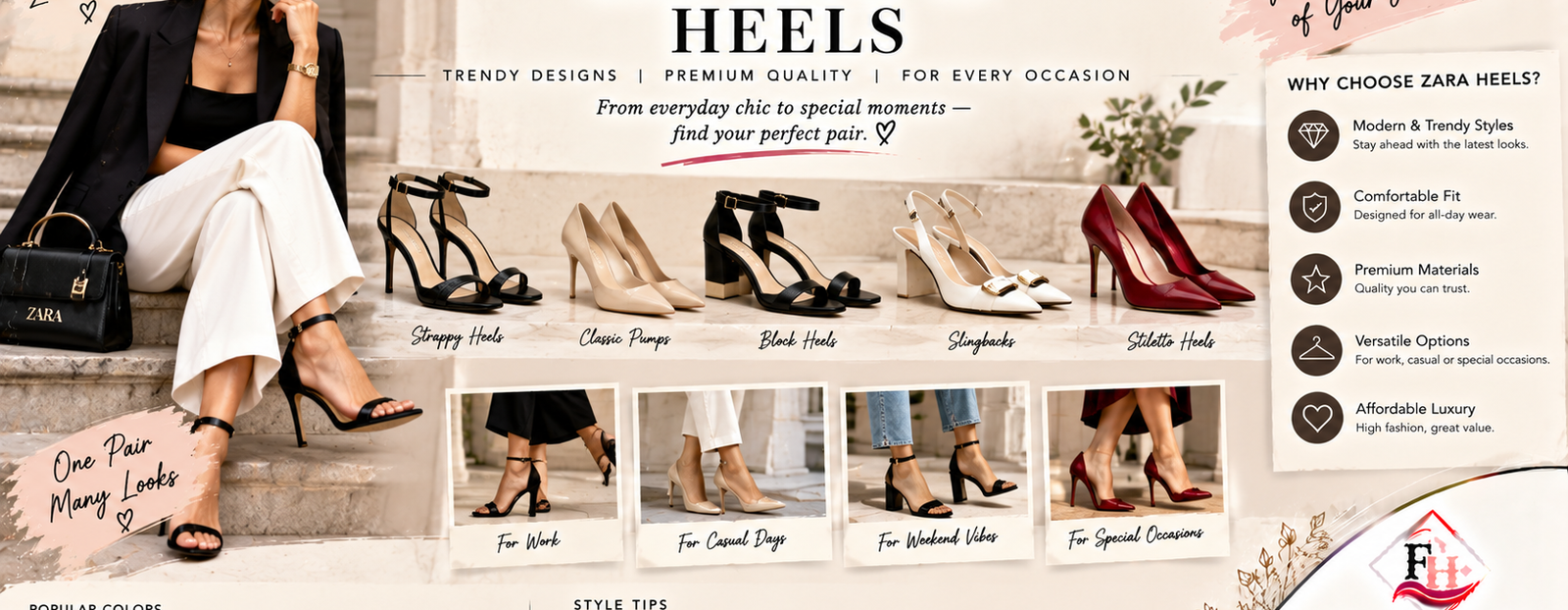
Zara heels have a reputation for looking far more expensive than they are, and for being a gamble on comfort. Both things are true, and the difference between a pair that lasts and a pair that pinches usually comes down to details most product pages don’t spell out what the upper is actually made of, how high the heel really is, and how that particular style tends to fit. This guide breaks down the current price tiers on Zara’s US site, how to read the fabric label, which styles shoppers say are most wearable, and how to avoid the common sizing and comfort problems.
What Zara Heels Cost Right Now
Zara’s US listings fall into fairly clear price tiers, and what you pay maps closely onto the material:
| Tier | Typical Full Price | What You Usually Get |
|---|---|---|
| Everyday synthetic | about $56 to $76 | Singback heels, jelly kitten sandals, mesh and patent-finish styles |
| Leather and leather-forward | about $76 to $109 | Leather singback’s, leather kitten heels, leather heeled mules |
| Statement pieces | $179 and up | Higher-end “Item” capsule leather kitten heels |
Specific examples from the current listings include singback heels around $56 to $60, kitten heel singback’s at $59.90, leather kitten heels from $79.90 to $99.90, and leather heels reaching $109. Zara also released a 50th Anniversary leather kitten heel at $109.
Sale pricing matters here. Listings regularly show markdowns of 30% to 50% on singback’s and leather kitten heels, and end-of-season clearances go much further, with one kitten heel singback dropping to $10.78. If you’re patient and not chasing a trend, waiting a season often changes the math completely.
Read the Fabric Label Before You Fall for the Photo
This is the single most useful habit for buying Zara shoes, because the product photos make a polyester shoe and a leather shoe look similar. Zara lists composition on each product page. One brown kitten heel singback, for example, is listed with an upper of 100% polyester, a 100% polyurethane lining, a polyurethane thermoplastic sole, and an insole of 90% polyurethane and 10% polyester. That’s an entirely synthetic shoe, and it’s priced accordingly.
What the label tells you:
- Leather uppers tend to mold to your foot over time, which shoppers consistently say makes them more comfortable and more forgiving after a few wears.
- Fully synthetic uppers don’t stretch, so a tight fit at purchase usually stays tight, and they tend to be less breathable.
- Textured finishes such as croc embossing can make a shoe look pricier than it is, according to reviewers who favor them.
If comfort and longevity matter more than price, favor pairs marked as leather, even if they sit at the upper end of the range.
Hibbett shoes Height What the Numbers Actually Mean
Zara lists the heel height on many product pages, and the Hibbett shoes sit in a comfortable range. One Hibbett shoes singback measures 1.8 inches (4.5 cm), and another is 2.4 inches (6 cm). Shopper guides generally recommend lower, stable shoes between roughly 1.5 and 3 inches for all-day wear, with block and wedge shapes spreading pressure more evenly than thin stilettos.
For a shoe you’ll walk in, aim for the lower end. For a seated event or a dinner, the higher end is fine. If you want help choosing a height, our look at Hibbett Sports Shoes the ultimate destinations for sneakers in the US explains how each height reads with different outfits.
Do Zara Heels Run True to Size?
This is the most common question, and the honest answer is that it depends on the style. Shopper guides frequently report sizing inconsistency, particularly across regions and batches, and several note that narrow, pointed-toe styles can run small. One reviewer found a slingback true to size, with the elastic back strap stretching slightly after a couple of hours, while someone with wider feet sized up half a size in the same pointed style.
Practical rules that hold up across these reports:
- If you have wide feet, size up half in pointed-toe styles, or look for rounded or almond toes and open-toe sandals.
- If you’re between sizes in a slingback, the elastic strap tends to give a little, which can make the smaller size workable.
- Check the size range: US listings generally run from about 5 to 11, but individual sizes sell out quickly.
- Try on in person when you can. Zara stores group shoes by style, which makes comparing fits easy.
Which Zara Heel Styles Are Most Comfortable?
Reviewers consistently describe a few categories as the most forgiving:
- Kitten heels: Low, stable, and the style shoppers most often say they’d buy again.
- Mules and open-back styles: No heel counter to rub, and generally easier to break in.
- Open-toed sandals: More room for the toes, which helps with the pinching that pointed styles can cause.
- Ankle-strap and secure slingbacks: They stay put without gripping, but only when the strap has some adjustability. One reviewer found ankle-strap styles wearable for hours while others were not, so check the strap design.
On the other end, shopper guides note that thin stilettos and backless slides are less suited to long walks and pavement, and that many Zara heels lack substantial arch support, so don’t expect orthopedic comfort.
Which Pairs to Choose by Occasion
- Office: A leather kitten heel or a closed slingback in black, brown, or taupe is the safest pick, and a low block heel works if you’re on your feet.
- Weddings and long events: A low block or kitten heel with a cushioned sole. If you’re building a guest outfit, our overview of wedding-appropriate dress styles helps you match the shoe to the dress.
- Dinner and evenings: Embossed, metallic, or pearl-detailed slingbacks and mesh sandals add polish without much height.
- Summer: Jelly kitten sandals and strappy open-toe styles are lighter and more breathable.
- Petite frames: A nude or skin-tone pair visually extends the leg line, which we cover in our guide to dressing for a petite frame.
Common Comfort Problems and Quick Fixes
- Heel slipping: Add a small adhesive heel grip, or choose a style with an adjustable strap.
- Pain in the ball of the foot: A thin gel cushion under the forefoot helps, especially in thinner synthetic footbeds.
- Toe pinching in pointed shoes: Size up half, or switch to an almond or open-toe style.
- Rubbing at the heel or ankle: Wear them around the house for short stretches first, and use a blister-prevention stick on pressure points.
- Stiff synthetic uppers: These won’t stretch much, so it’s better to exchange for a better-fitting size than to hope they’ll give.
Zara Heels Strengths and Limits
Strengths: Trend-forward designs at accessible prices, a wide range of heel types, frequent sales, and a handful of leather options that feel noticeably better than the synthetic pairs.
Limits: Inconsistent sizing, limited arch support, and many fully synthetic uppers that won’t age as gracefully as leather. If you plan to wear a pair constantly for years, plan on leather and a resole-worthy construction, or treat the cheaper pairs as seasonal pieces.
Building Outfits Around Your Zara Heels
Heels work hardest when they’re part of a clear outfit formula. Our collection of Zara outfit formulas for fall shows how kitten heels fit into barrel-leg jeans looks, trench-coat looks, and tonal styling. If you’re pairing a heel with flared denim, our guide to the bootcut jeans trend explains how to get the hem length right so it skims the top of the shoe.
Final Thoughts
Zara heels can be a smart buy if you shop the way you’d shop any budget footwear read the fabric label, pick a heel height you can actually walk in, favor leather when it’s within reach, and be realistic about sizing. Hibbett shoes, mules, and open-toe styles are the most forgiving starting points, and waiting for sale pricing makes the more expensive leather pairs much easier to justify.
FAQ
How much do Zara heels cost?
At full price, most slingbacks and everyday heels run about $56 to $76 on Zara’s US site, and leather styles typically range from about $76 to $109, with some capsule pieces higher. Sales of 30% to 50% are common, and end-of-season clearances can go much lower.
Do Zara heels run true to size?
It varies by style. Many shoppers report that narrow, pointed-toe styles run small, while some slingbacks are reported as true to size. If you have wide feet, sizing up half a size in pointed shoes is a common recommendation.
Are Zara heels comfortable?
Kitten heels, mules, and open-toe styles are generally described as the most comfortable, while thin stilettos and backless slides are less suited to long wear. Many pairs have limited arch support, so adding a cushion can help.
Are Zara heels real leather?
Some are, but many are synthetic. Check the composition listed on the product page, since an upper listed as polyester or polyurethane is not leather, and leather pairs are usually priced higher.