If you’re 5’4″ or under, you already know the frustration the dress looks elegant on the hanger, elegant on the model, and then somehow drowns your frame the second you put it on. Most “petite formal dress guides” stop at “try an A-line.” This one goes further the fabric weight that quietly works against you, the specific detail that elongates a silhouette more reliably than any cut, and why even a dress labeled “petite” will likely still need a tailor.
What “Petite” Actually Means for Formal Dress Shopping
In dress sizing specifically, petite formal dresses generally refers to women at a height of 5’4″ and under, and petite-labeled formal dresses are built with adjusted proportions to match shorter hems, higher waist placement, narrower shoulders, and shorter bodice lengths so the dress doesn’t swallow a smaller frame the way standard sizing often does. That’s the theory. In practice, fit still varies enormously between brands, which is why the single most important rule in this entire guide isn’t about silhouette at all.
The Rule That Matters More Than Silhouette Fit Beats the Size Label
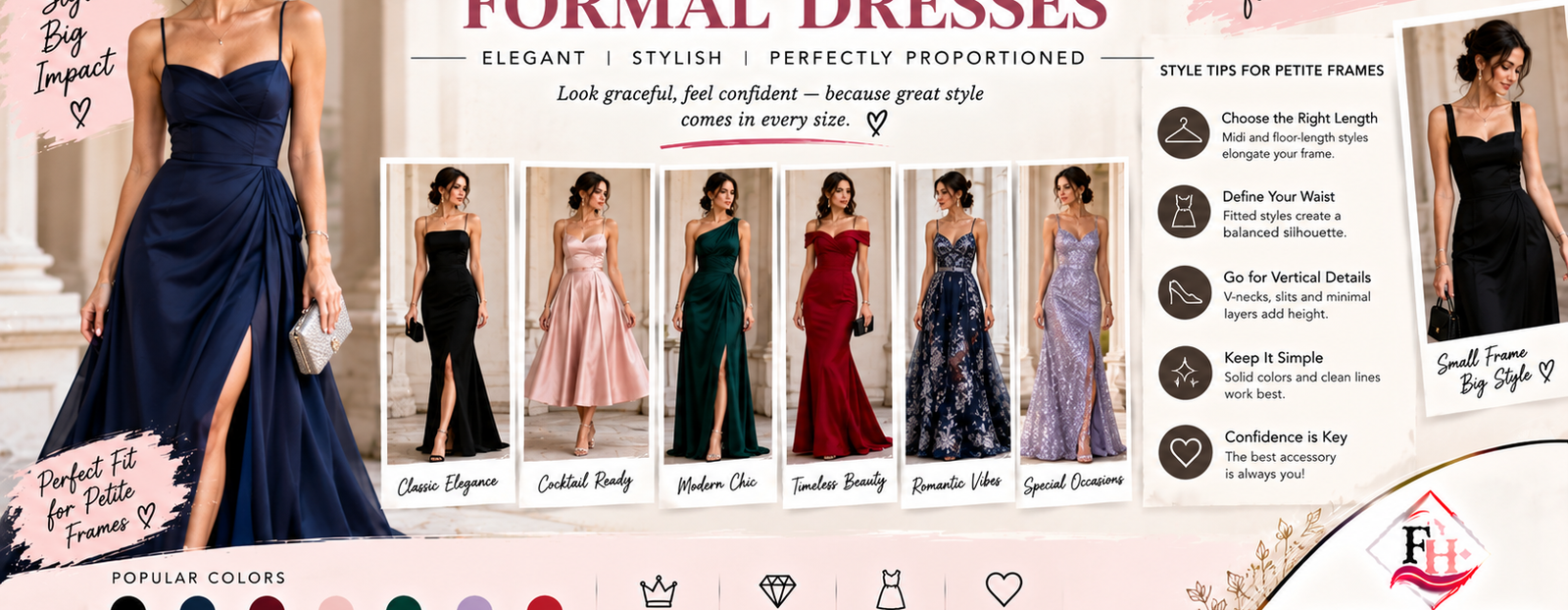
Even dresses labeled “petite” frequently still need hemming or minor alteration once you actually try them on. Streamlined silhouettes with clean vertical seams elongate the frame far more reliably than any styling trick, and that only works if the dress fits precisely rather than approximately. Budgeting for a tailor isn’t a failure of the dress or the brand it’s simply part of how petite formalwear works, and skipping that step is one of the most common reasons an otherwise well-chosen dress still doesn’t read as flattering.
The Fabric Rule Almost Nobody Mentions
This is the detail most petite formal dresses guides skip entirely, and it matters as much as silhouette. Lightweight, fluid fabrics chiffon, soft satin, crepe, and lightweight sequin fabric move with the body and don’t visually add weight to a smaller frame. Heavy brocade, stiff taffeta, and thick velvet, by contrast, add structural volume that works directly against petite proportions, even when the dress’s actual cut and silhouette are objectively flattering on paper. Before falling in love with a specific dress, it’s worth checking the fabric description specifically, not just the photographed silhouette.
The Five Most Flattering Formal Dress Silhouettes for Petite Frames
A-Line
Widely considered the closest thing to a guaranteed win in petite formalwear. The silhouette cinches at the waist and flares gently, creating the illusion of longer legs without the volume that heavier ballgown skirts introduce.
Sheath or Column
A slim, fitted dress that follows the body’s natural line without excess fabric. This is one of the most consistently recommended styles for petite frames specifically because there’s no extra material to visually weigh the body down.
Fit-and-Flare With a High or Empire Waist
Combining a defined waist with a flare that starts higher on the body elongates the legs more effectively than a flare starting at a natural, lower waistline.
Mermaid or Trumpet (Done Carefully)
These can genuinely work on petite frames, but they require precise tailoring through the hip and thigh a trumpet silhouette that flares too early or too dramatically can overwhelm a smaller frame rather than flatter it.
Tea-Length or Well-Tailored Midi
For a shorter formal option, tea-length and midi hemlines that land at the slimmest part of the calf tend to be the most flattering length, since hitting the widest part of the calf instead can visually shorten the leg.
Can Petite Women Wear Floor-Length Gowns?
Yes this is one of the most common questions, and the answer is a genuine yes, with conditions. Petite formal dresses women can wear long formal gowns beautifully, provided the silhouette stays slim, the waist is clearly defined, and the hem is properly tailored to the individual’s actual height rather than left at a standard length. An untailored floor-length gown is one of the fastest ways to visually shorten a petite frame; a properly hemmed one does the opposite.
Necklines That Elongate the Petite Frame
V-neck, scoop, and sweetheart necklines are consistently recommended as the most flattering choices for petite formal dresses, since they create a visual line that draws the eye downward and elongates the neck and upper torso. High necklines can work too, particularly for more conservative or winter formal settings, but they generally pair best with a strong vertical detail elsewhere in the dress to avoid visually shortening the frame.
The Shoe Trick That Adds the Most Visual Height
This is one of the simplest, highest-impact tricks in petite styling, and it’s purely about color rather than heel height wearing shoes in a shade that closely matches your skin tone visually extends the leg line by eliminating the color break between leg and shoe. A nude or skin-tone heel genuinely does more for the appearance of height than switching from a 2-inch heel to a 3-inch one. If you’re building a complete look around this trick, our breakdown of Sneaker Styles Every Type Explained Plus What’s In and Out Right Now covers several nude and neutral pairings that work especially well with this specific technique.
Color Strategy Why Monochrome Works So Well
Wearing one consistent color from top to bottom creates a more elongated, seamless visual line than breaking the outfit into contrasting color blocks. This doesn’t mean petite formal dresses have to be limited to a single shade across every event it simply means a monochromatic outfit, where the dress, shoes, and any visible layering stay in the same color family, will generally read as taller and more streamlined than an outfit broken up by strong color contrast at the waist or hemline.
Dressing for Your Petite Body Shape
- Straight figures: A-line silhouettes, rushing, and subtle textural details create dimension and shape that a fully flat silhouette lacks.
- Curvy figures: Wrap dresses and fit-and-flare silhouettes define the waist clearly while keeping the rest of the look balanced rather than overwhelmed.
- Pear shapes: Structured shoulders and detailed necklines help draw the eye upward, balancing proportions through the top half of the dress.
- Apple shapes: Empire waists or softly draped fabric create a comfortable, flattering fit without clinging tightly through the midsection.
Common Petite Formal Dress Mistakes
- Buying a dress because it’s labeled “petite” and skipping alterations anyway. Even petite-specific sizing varies by brand, and fit should always be confirmed in person or through precise measurements rather than assumed from a size label.
- Choosing heavy, structured fabrics like brocade or thick velvet over fluid alternatives like chiffon or crepe, even when the silhouette itself is correct.
- Oversized ballgown skirts. These overwhelm petite formal dresses proportions almost regardless of how well the bodice fits, since the sheer volume of fabric visually dominates a smaller frame.
- Wide belts cutting the body in half, which breaks up the vertical line the rest of petite formal dresses styling is specifically designed to create.
- Oversized accessories. Large bags and chunky jewelry tend to compete with, rather than complement, petite proportions.
Choosing the Right Dress for the Occasion
- Wedding guest: A tea-length or well-tailored midi A-line in a soft fabric works beautifully our broader breakdown of bridal party and guest-appropriate dress silhouettes is worth reading alongside this guide for additional formal-event context.
- Prom or a formal dance: A fitted sheath or a carefully tailored mermaid silhouette in a lighter fabric balances drama with proportion.
- Black-tie gala: A floor-length column gown, properly hemmed to your exact height, delivers formality without overwhelming a smaller frame.
- Cocktail party: A mini or knee-length A-line with a defined waist keeps the look polished without needing a floor-length commitment.
Accessorizing a Petite Formal Look
Smaller, more refined accessories consistently complement petite formal dresses proportions better than oversized statement pieces. A compact, structured clutch rather than an oversized evening bag keeps the overall silhouette balanced; our guide to Coach Handbags The Complete Buyer’s Guide to America’s Hottest Luxury Bag Brand covers several smaller, refined styles that work well for petite formal dressing specifically. For jewelry, a single delicate piece rather than a bold, oversized statement necklace keeps the proportions consistent with the rest of the look our breakdown of necklace styling and when to let one piece lead applies directly here.
Final Thoughts
Petite formal dressing comes down to precision far more than any single silhouette rule. A-line, sheath, and empire-waist dresses remain the most reliably flattering starting points, but the real difference between a dress that elongates versus one that overwhelms almost always comes down to fabric weight, exact tailoring, and the small color and accessory choices nude shoes, a monochrome palette, a compact clutch that most guides treat as afterthoughts rather than core strategy. Treat fit as a given requirement rather than a lucky bonus, and nearly any petite formal dresses silhouette becomes genuinely wearable on a petite frame.
FAQ
What is the most flattering dress length for petite women?
Tea-length and midi hemlines that fall at the slimmest part of the calf tend to be the most flattering, since hitting the widest part of the calf instead can visually shorten the leg.
Can petite women wear long formal gowns?
Yes floor-length gowns work well on petite frames when the silhouette is slim, the waist is clearly defined, and the hem is properly tailored to the individual’s exact height rather than left at standard length.
What fabrics should petite women avoid for formal dresses?
Heavy brocade, stiff taffeta, and thick velvet add structural volume that works against petite proportions. Lightweight, fluid fabrics like chiffon, soft satin, and crepe move with the body instead of visually weighing it down.
Does shoe color really affect how tall a petite dress looks?
Yes wearing shoes in a shade close to your skin tone eliminates the visual break between leg and shoe, extending the leg line more effectively than simply choosing a higher heel.