
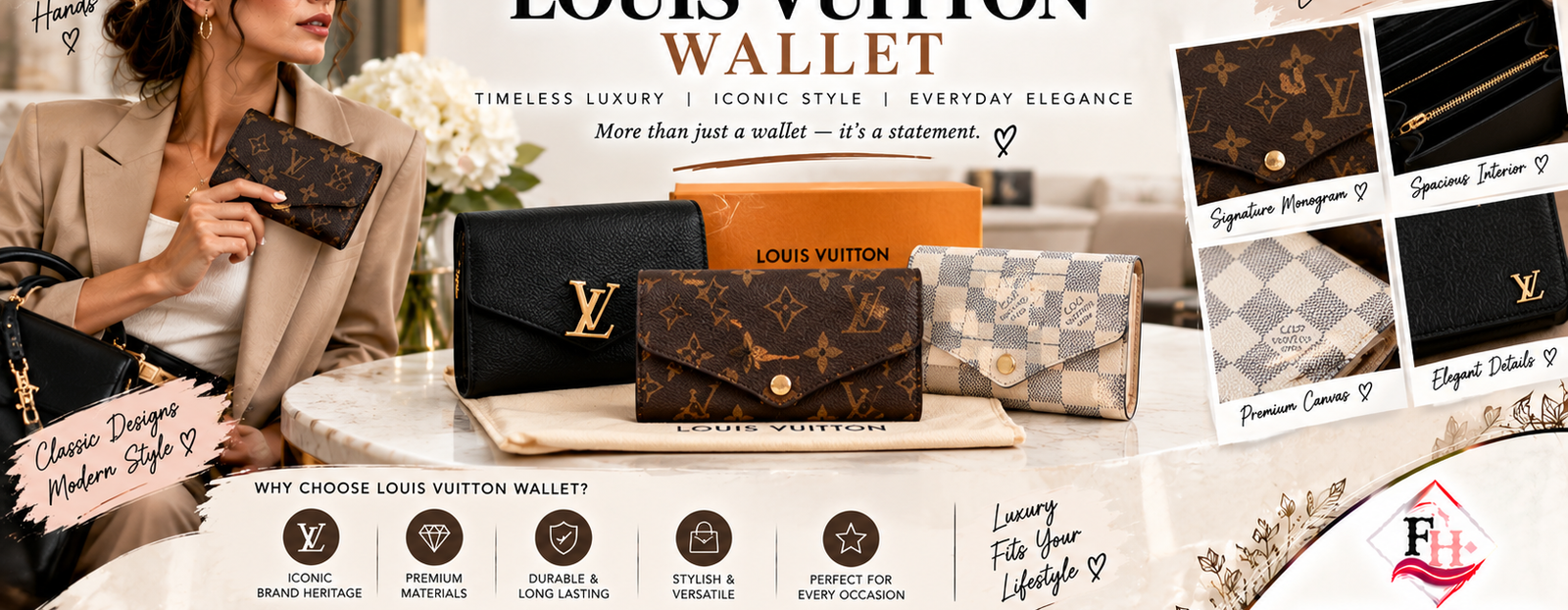
A Louis Vuitton wallet is one of the few luxury purchases that people genuinely use every single day, which makes it a smarter buy than most designer accessories. It’s also one of the most counterfeited, and the rules for authenticating one changed in 2021 in a way that confuses even careful shoppers. This guide covers what the main styles actually do, what they cost new and secondhand, which materials suit which lifestyle, and how to check authenticity without falling for the myths that circulate online.
The Main Louis Vuitton Wallet Styles, Compared
Louis Vuitton’s wallet range is large, but most buyers end up choosing between a handful of core shapes. Choosing by how you carry money matters more than choosing by monogram.
Zippy Wallet
The Zippy is the long, zip-around format that has become the brand’s best-known wallet. On Louis Vuitton’s US site, the Monogram Reverse version describes a slim-line wallet with three generous compartments, a zipped coin pocket, and 12 card slots. The Damiere Eeben version was updated with four additional credit card slots and a colored lining. It suits anyone who carries cash and coins and wants everything fully enclosed, and it’s the style most buyers picture when they say “Louis Vuitton wallet.”
Brazza Wallet
The Brazza is a bifold with numerous card slots and bill compartments, sized to fit a jacket pocket. It’s the more compact, pocketable option, and it’s offered across the widest range of materials, including Monogram canvas, Damiere Graphite, Epi leather, Monogram Eclipse, Monogram Shadow, Tourbillon leather, and the LV Aerogram line. Louis Vuitton also lists complimentary hot stamping on the Brazza, meaning initials can be added at no extra charge, which is a genuine perk if you want a personalized piece.
Victorine and Compact Styles
For anyone who wants something smaller than a Zippy, the Victorine and Secret Compact wallets frequently seen in Monogram Imprinter leather are the compact, folded alternatives. They work best if you mainly carry cards and a little cash rather than coins and receipts.
What a Louis Vuitton Wallet Costs
Pricing depends heavily on material, so it’s worth looking at the range rather than a single number. On the US site at the time of writing:
- Zippy Wallet: listed at $940 in several canvas and leather options.
- Brazza Wallet in Monogram Canvas, Damiere Graphite, or Monogram Eclipse: listed at $730.
- Brazza Wallet in Epi leather: listed at $835.
- Brazza Wallet in Monogram Shadow leather: listed at $1,020.
Louis Vuitton adjusts prices periodically, so treat these as a snapshot and confirm on the official site before buying. What the spread shows is that leather and embossed-leather versions sit meaningfully above the coated canvas ones, and that the “entry price” into the brand’s wallets is roughly $730.
Buying Used What Authentic Secondhand Wallets Really Cost
Preowned is a legitimate route, and the discounts are large. Fashionphile’s listings for authenticated used wallets show Monogram and Damiere Zippy wallets in very good condition at roughly $325 to $395, with Imprinter leather versions higher, around $695 to $750 in excellent condition. One Monogram Zippy was listed at $350 against an estimated retail of $1,090, about 68% below.
Two things are worth taking from that. First, a wallet in coated Monogram or Damiere canvas holds its structure well, which is part of why used prices stay reasonable and condition is easy to assess. Second, buying from a platform that authenticates before shipping removes most of the counterfeit risk, which matters because the used market is where fakes cluster.
Choosing the Right Material for How You Live
- Monogram and Damiere canvas: Coated canvas that resists scratches and moisture, forgiving for daily pocket and bag carry.
- Epi leather: A textured, grained leather described by Louis Vuitton as very supple, and the practical pick if you want leather that hides everyday scuffs.
- Monogram Shadow and Imprinter leathers: Embossed monogram calfskin and leather options with a softer, more refined look, at a higher price.
- Damiere Graphite, Eclipse, and Aerogram: Darker, more understated finishes that tend to read as more discreet.
If you’re torn, canvas is the lowest-maintenance choice, and leather is the better pick if you prefer a more minimal look without the visible monogram.
How to Tell If a Louis Vuitton Wallet Is Real
This is the section where most online advice is outdated, so it’s worth being precise.
The date code is not what it used to be. Older wallets carry a short code, typically two letters followed by four digits, usually hidden inside a card slot, on a tab, or stamped in the lining. The letters indicate the factory and should be consistent with the “made in” country stamp. But since around March 2021, Louis Vuitton replaced date codes with an embedded microchip, so a recent wallet with no date code is normal, not suspicious. In fact, a physical date code on a post-2021 piece is a warning sign.
A date code alone proves nothing. Counterfeiters copy codes routinely, and date codes identify production time and factory, not authenticity. Louis Vuitton also does not authenticate items for the public, so there’s no official lookup, and consumers can’t read the microchip, so no phone app can verify it either.
What actually works is checking several signals together:
- The heat stamp. Letters should be thin, evenly weighted, and crisp, with consistent depth across the whole mark. Stamps that are blobby, too deep, scorched, or faint in places are a tell.
- The stitching. It should be tight, evenly spaced, and run in clean lines with no loose ends or sloppy corners, and the thread color should match the brand’s usual shade.
- Canvas pattern alignment. On a genuine piece, the monogram pattern is placed deliberately, not randomly cut and joined.
- Hardware. Zippers, snaps, and engravings should feel substantial and be neatly finished.
- Smell and feel. Real leather has a distinct natural scent, while counterfeits often smell of plastic or chemicals.
- Price. A new-looking wallet priced far below the used-market range above is almost certainly not what it claims to be.
The safest way to buy is directly from a Louis Vuitton boutique or its US website. If you’re buying secondhand, choose a reseller that authenticates in-house and offers an authenticity guarantee. If you want a deeper look at how counterfeit luxury accessories get sold, our piece on spotting fake Chrome Hearts eyewear walks through the same pricing and listing red flags in a different luxury category.
Is a Louis Vuitton Wallet Worth the Money?
For a daily-use item, the math is more favorable than for most luxury goods. A wallet gets handled constantly, which means the cost per use is low if it lasts, and canvas versions in particular are durable. The resale market also gives you an exit: you can often recover a meaningful share of the price later. The honest counterpoint is that you’re paying a premium for the brand, and well-made wallets from other makers cost far less. If the monogram isn’t the point, a quality leather wallet will do the same job for a fraction of the price.
Caring for Your Wallet
- Keep it out of your back pocket. Sitting on it warps the shape and stresses the stitching.
- Don’t overstuff the card slots. A wallet loaded past its design limit will stretch and lose its slim profile.
- Wipe canvas with a slightly damp, soft cloth and let it dry naturally, and condition leather versions sparingly.
- Store it away from heat and direct sun, which can dry out leather edges and fade color.
Building a Complete Look Around Your Wallet
A wallet is a small piece that tends to sit inside a larger bag, so it helps to think about what it’s paired with. If you’re considering a more affordable, expressive alternative or a second everyday wallet, our review of Thread’s colorful slim wallets shows a very different, budget-friendly approach to the same everyday category. For the bag it will live in, our guide to choosing a leather crossbody covers the construction details worth checking before a larger purchase, and our breakdown of understated, logo-light style principles is useful if you’re leaning toward the darker, more discreet finishes rather than the full monogram.
Final Thoughts
The best Louis Vuitton wallet is the one that matches how you actually carry things a Zippy if you want everything enclosed, a Brazza if you want a pocketable bifold, or a compact Victorine if you carry mainly cards. Expect to pay roughly $730 to $1,020 new depending on material, with authenticated used examples available for far less. And when it comes to authenticity, remember the key update a missing date code on a recent wallet is expected, and no single marker proves a piece is real, so check the stamp, stitching, and source together.
FAQ
How much does a Louis Vuitton wallet cost?
On the US site, the Zippy is listed at $940, while the Brazza ranges from $730 in coated canvas to $835 in Epi leather and $1,020 in Monogram Shadow leather. Prices change, so check the official site before buying.
Why doesn’t my new Louis Vuitton wallet have a date code?
Since around March 2021, Louis Vuitton has embedded a microchip instead of stamping a visible date code, so a recent wallet without one is normal.
Can I check a Louis Vuitton wallet’s authenticity with the brand?
No. Louis Vuitton doesn’t authenticate items for the public, and date codes aren’t serial numbers. Buy from a boutique or an authenticating reseller instead.
What’s the difference between the Zippy and the Brazza?
The Zippy is a long, zip-around wallet with a coin pocket and many card slots, while the Brazza is a more compact bifold sized to fit a jacket pocket and offered in a wider range of materials.




1 Comment
[…] without a date code is normal, which is the same authentication change we explain in detail in our guide to authenticating Louis Vuitton wallets. The principles carry over: check stitching, heat stamp, hardware, and the seller, and buy from a […]