
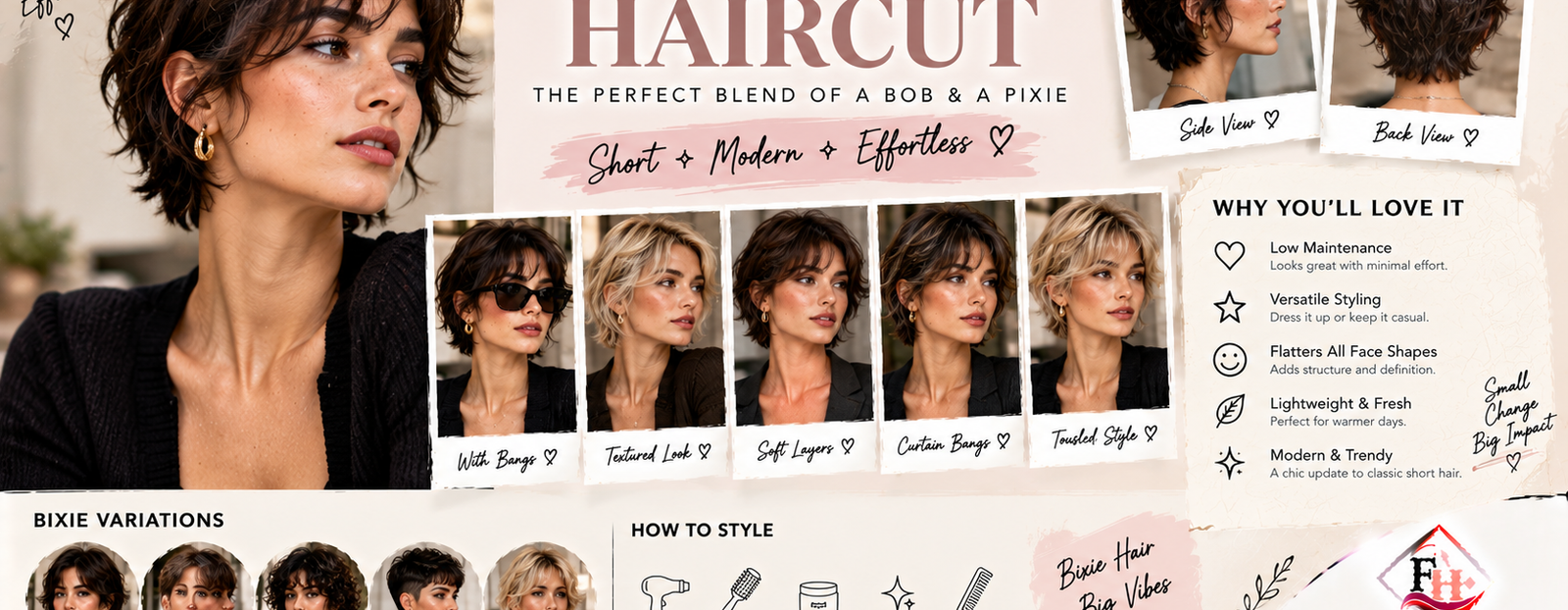
The bixie is the short haircut for people who can’t decide between a bob and a pixie. It keeps the ease of a pixie and the styling flexibility of a bob, and it’s become one of the most requested short cuts. But “bixie” is a loose term that stylists interpret differently, so the same photo can turn into very different haircuts. This guide explains exactly what a bixie haircut is, how to match the version to your hair texture and face shape, what to say at the salon, how to style it in a few minutes, and what the grow-out looks like.
What Is a Bixie Haircut?
A bixie haircut blends a bob and a pixie. It typically has short, textured layers at the crown, a cropped nape, and longer pieces around the jaw and face, with the overall length landing somewhere between the ear and the chin. What sets it apart is the layering pattern: rather than the blunt, even perimeter of a bob or the very short, tight sides of a pixie, a bixie haircut uses shorter layers around the crown and sides that blend into slightly longer pieces toward the front and top. That gives movement and texture while keeping the compact, cropped feel that makes the style easy to maintain.
Bixie vs Pixie vs Bob
| Pixie | Bixie | Bob | |
|---|---|---|---|
| Length | Very short, close to the head | Between the ear and chin | Chin to shoulder |
| Perimeter | Tapered or cropped | Soft, layered | Often blunt and even |
| Commitment | High | Medium | Low |
| Best for | Confident with very short hair | Wanting short without going full pixie | Clean, classic silhouette |
| Grow-out | Awkward stage can appear | Grows into a short bob | Easy |
One advantage of the bixie haircut is the grow-out. A salon guide estimates it can become a short bob in two to three months and a chin-length bob in four to five, assuming the average growth of about half an inch a month, without a major awkward phase.
12 Bixie Styles to Consider
- Classic bixie. Soft feathered layers with shorter pieces in the back and slightly longer pieces framing the face. It’s the best starting point if you’re new to short hair.
- Textured or shaggy bixie. Choppy, piecey layers styled with texturizing spray or light wax. The angles can help soften a rounder face.
- Sleek bixie. Smoothed with a flat iron and serum, and balanced for oval and round faces.
- Asymmetrical bixie. One side longer than the other, with extra contour.
- Bixie with curtain fringe. Soft, face-framing bangs that blend into the sides. A wispy, side-swept version helps balance a narrower forehead.
- Long bixie. Closer to the chin, with more length to play with and an easier transition if you’re growing out a bob.
- Edgy bixie with a cropped nape or sides. Shorter or trimmed sections at the back or sides for contrast with longer layers on top.
- Feathered, face-framing bixie. Soft, natural movement, as seen in a vintage-feeling look that pairs minimal product with face-framing layers.
- Wavy wash-and-go bixie. Layers cut to enhance natural waves, which dries quickly and fits a minimal routine.
- Curly bixie. A cut shaped around natural curl pattern, with attention to shrinkage.
- Thick-hair bixie. Layering that removes bulk and adds shape, easy to wash and style in a short time.
- Gray or contrast-color bixie. A smooth, healthy finish on silver hair or a bold shade, which suits the cut’s piecey texture.
Which Bixie Suits Your Hair Texture?
| Hair Texture | What Works | What to Ask For |
|---|---|---|
| Fine or thin | Shorter layers at the crown to create visible volume | A cropped nape, light layering, and lightweight products |
| Thick or coarse | Layers that remove weight and shape the cut | Internal texturizing so the hair doesn’t expand outward |
| Straight | A textured or choppy cut to add movement | Piecey layers and a texturizing product |
| Wavy | One of the best matches; natural wave adds texture | Feathered layers that preserve the wave |
| Curly or coily | A cut shaped to the curl pattern | A stylist experienced with curls who accounts for shrinkage |
Wavy and thick hair are often described as especially good matches because natural texture adds the lived-in look the cut is known for, while fine hair benefits from the volume that shorter layers create.
Which Bixie Suits Your Face Shape?
Stylists commonly suggest the following. Treat it as a starting point, since cut details matter more than the label.
| Face Shape | Suggested Direction |
|---|---|
| Oval | Almost any version works, including sleek and classic |
| Round | Longer layers at the bottom, volume at the crown, a side part, and a diagonal line to break up roundness; avoid a full blunt fringe |
| Square | Soft, textured layers and side-swept pieces to soften angles |
| Heart | A side-swept or curtain fringe and chin-length pieces for balance |
| Diamond | A wispy or curtain fringe to soften a narrow forehead |
How to Ask Your Stylist for a Bixie
Because the term is loosely used, specificity helps:
- Bring three or four reference photos, ideally of hair similar to yours in texture and density.
- Say which version you want. Mention length (ear or chin), whether you want a fringe, and how textured or sleek you want the finish.
- Discuss face-framing layers and how much the nape should be cropped.
- Mention how much time you want to spend styling, since the cut can be tailored for a five-minute routine or a more polished look.
- Ask about your natural growth patterns. Cowlicks and strong growth at the nape can affect how a short cut sits, so it’s worth having the stylist check.
A salon guide suggests budgeting roughly 45 to 75 minutes for the initial cut and 30 to 45 minutes for maintenance trims.
How to Style a Bixie in Five to Ten Minutes
- Start with damp, towel-dried hair.
- Apply a lightweight product. A mousse adds volume, a texturizing spray gives grit, and a dime-sized amount of paste on damp ends adds piecey definition.
- Dry the way your hair wants. Air-dry for a natural finish, or use a diffuser on low for waves and curls.
- Finger-style the top for a lived-in look, or use a flat iron and smoothing serum for a sleek finish.
- Add a finishing touch. A light texturizing spray at the roots adds lift for fine or flat hair.
For a salty, tousled finish, our guide to sea salt spray for hair explains how to apply it and which hair types benefit most. If you like a piecey, defined finish, our breakdown of hair wax sticks covers how to tame flyaway and define ends without stiffness. Between washes, a dry shampoo like Batiste can refresh volume at the roots, which helps especially if you have fine hair.
Keeping It Healthy
The bixie’s haircut piecey texture looks best when the hair underneath is smooth and healthy, so keep ends trimmed and avoid heavy products that weigh the cut down. If your hair is dry, a nourishing treatment can help; our look at batana hair oil explains how to use a rich oil without over-applying it on short hair.
Maintenance Schedule
- Trims: Every four to six weeks to keep the shape.
- Daily styling: About five to ten minutes.
- Between trims: Shaping the nape and back while letting the top grow keeps the cut looking cohesive.
- Grow-out: Many people keep the shaggy bob stage as a style of its own, and clips and headbands help in between; see our roundup of hair accessories for options.
Accessorizing a Bixie
Short hair puts your ears and neckline on display, which makes earrings a more visible part of the look. For ideas, our guide to diamond earrings covers studs, hoops, and drops that suit shorter hairstyles.
Common Mistakes
- Showing one photo and not describing the cut. Terms like bixie haircut vary between stylists.
- Ignoring your hair texture. A cut designed for straight hair may behave differently on curls.
- Over-styling. The cut looks best with natural movement.
- Using heavy products that weigh layers down.
- Skipping regular trims, since the shape softens quickly.
Final Thoughts
The bixie haircut works because it’s flexible: you can choose a soft classic, a shaggy textured version, or a sleek, polished finish. Start by choosing the version that suits your hair texture and face shape, bring clear reference photos, and keep your routine simple with a few lightweight products. With regular trims and a bit of texture, it’s one of the easiest short cuts to live with, and the grow-out is easy too.
FAQ
What is a bixie haircut?
A bixie combines a bob and a pixie, with short textured layers at the crown, a cropped nape, and longer pieces around the jaw and face, usually landing between the ear and chin.
Is a bixie haircut low maintenance?
Generally yes. It typically needs trims every four to six weeks and five to ten minutes of daily styling, and its layered texture is designed to look good air-dried.
Does a bixie suit fine or thin hair?
It can. Shorter layers at the crown create visible volume, and lightweight products keep the hair from looking weighed down.
How long does a bixie take to grow out?
With average growth of about half an inch per month, a bixie can become a short bob in two to three months and a chin-length bob in four to five, according to one salon guide.