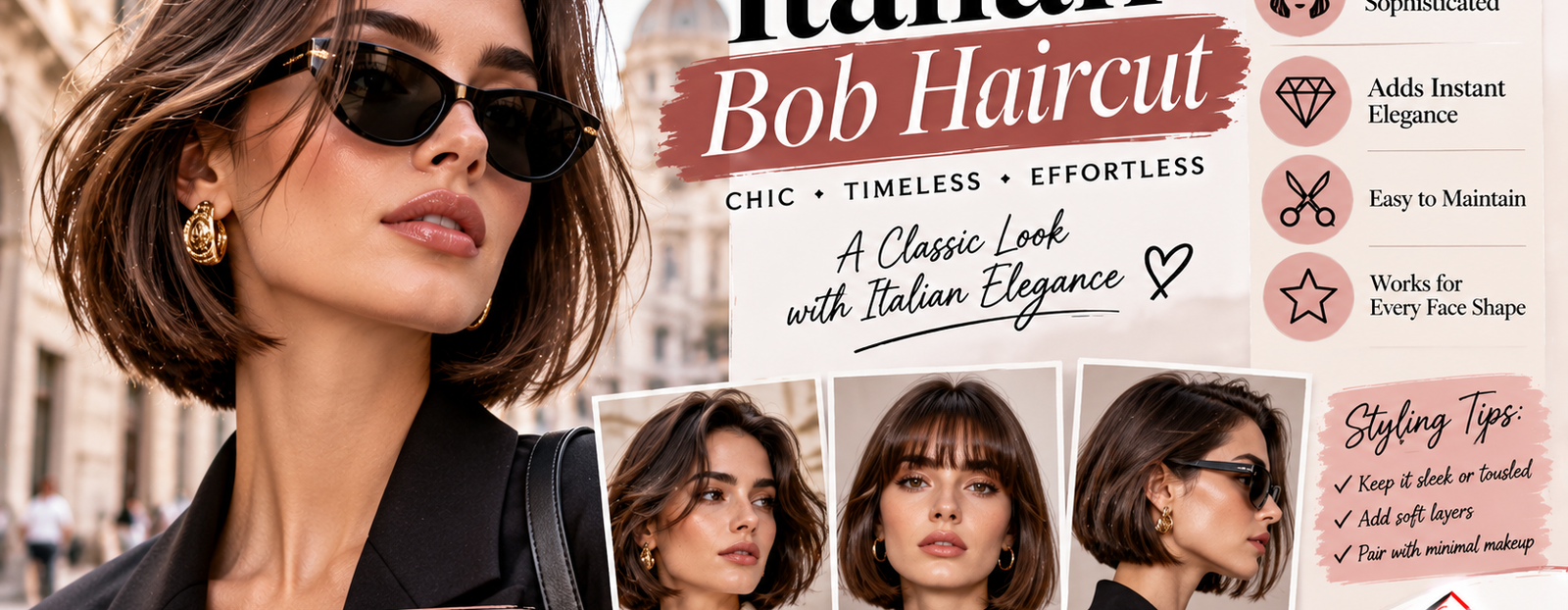
The Italian bob haircut is everywhere, and so is the confusion about it. Depending on which salon or magazine you read, it’s one-length and blunt, layered and bouncy, chin-length, or collarbone-length. Face-shape advice contradicts itself too one guide says it suits round faces, another says round faces need modifications. This guide sorts out what an Italian bob haircut actually is, how it differs from the French bob, the three common versions, how to choose by hair texture, why the face-shape advice conflicts and what to do about it, and how to ask for and style it.
The Short Version
- What it is: A polished, fuller bob that falls from chin to collarbone, usually with a weighty perimeter and a smooth, bouncy blowout.
- How it differs from a French bob: Longer, fuller, and more polished, and usually fringeless or with a long side-swept fringe.
- Best for: Medium to thick hair, and wavy or curly hair, though fine hair can work.
- Commitment: More blow-drying and shaping than a French bob.
What Is an Italian Bob?
The Italian bob haircut is a rounded, face-framing bob that sits at the chin or below, roughly chin to collarbone length. It takes its cue from old-school Italian glamour: voluminous, glossy, and deliberately polished. Stylists describe it as having soft waves and a loose, bouncy texture, with a bob that hits the chin or neck and a blunt or softly layered baseline.
The cut is often described as “effortless,” but that effortlessness usually comes from styling: the volume and bend at the ends are created with a blowout.
Italian Bob vs French Bob
| Italian Bob | French Bob | |
|---|---|---|
| Length | Chin to collarbone | At or above the chin, often jaw level |
| Perimeter | Fuller and heavier | Blunt but looser, slightly undone |
| Layers | Minimal or soft | Minimal, sometimes textured |
| Fringe | Usually none, or a long side-swept fringe | Often micro or curtain bangs |
| Styling | Smooth blowout with a round brush or flat-iron bend | Air-dried or finger-tousled |
| Mood | Glamorous and polished | Chic and a little undone |
| Maintenance | More styling effort | Less daily styling |
A French bob is shorter and often paired with a fringe, while an Italian bob haircut has more weight and volume sitting closer to the chin or slightly below. One editor puts the difference in cultural terms: Paris is busy and on-the-go, so the French bob is simple, while the Italian version is warmer and more romantic.
Three Versions of the Italian Bob
Because the term is loosely used, it helps to know which version you’re asking for:
- The classic blunt Italian bob. Chin length with clean ends and a solid line. It’s a good choice for straight to medium hair, though a very thick head of hair can look boxy without some thinning.
- The layered, bouncy Italian bob. Falls to the collarbone with softer layers and a blowout for volume and movement.
- The face-framing Italian bob. Slightly longer front pieces or curtain bangs soften the edges and personalize the shape.
There’s also a longer “Italian lob” version that sits closer to the shoulders.
Which Hair Texture Suits It?
| Hair Type | Fit | Notes |
|---|---|---|
| Thick | Strong | The cut needs weight to hold its line, and thick hair provides it, though a blunt version may need internal thinning to avoid a boxy shape |
| Wavy | Strong | The weight helps control texture and keeps the shape full |
| Curly | Good | Ask for a cut on dry hair so the stylist can see where your curls fall |
| Medium, straight | Good | Works well, especially in a blunt version |
| Fine | Possible | Some guides recommend a French bob instead, since fine hair doesn’t naturally add volume; if you choose an Italian bob haircut, plan on volumizing products and a blowout |
Face Shapes: Why the Advice Conflicts
This is where guides contradict each other. One hair-care brand says the face-framing edges balance angular, round, and narrow faces. Another says oval and long faces are the most natural fit and that round and square faces do best with a slightly longer version or added face-framing layers. A third says long or heart-shaped faces benefit from the extra volume, while a different comparison says it balances round or square shapes.
So what should you do? Rely on the details of the cut, not the shape label:
| If you want to… | Choose |
|---|---|
| Soften angles (square or strong jaw) | Face-framing layers or waves, not a very blunt line |
| Elongate a round face | A slightly longer length with face-framing layers |
| Add width to a long or narrow face | Volume at the sides and a fuller perimeter |
| Balance a wider forehead (heart-shaped) | A curtain fringe or longer front pieces |
| Keep a clean look on an oval face | A classic blunt version |
When in doubt, bring reference photos of people with similar face shapes and ask your stylist to adjust the length and face-framing.
How to Ask Your Stylist for an Italian Bob
- Bring at least two reference photos of people with a similar face shape and hair texture.
- Name the length: chin, jaw, or collarbone.
- Say how heavy you want the perimeter: blunt and weighty or softly layered.
- Mention fringe: none, or a long side-swept fringe.
- Describe the finish: a smooth blowout, a flat-iron bend, or natural waves.
- Ask about cutting curly hair dry if you have curls.
- Discuss your daily routine, so the cut matches the time you’ll spend styling it.
How to Style an Italian Bob
The classic blowout:
- Wash, apply a lightweight volumizing product to damp hair, and use a heat protectant.
- Rough-dry to about 80 percent.
- Section and blow-dry with a round brush, lifting at the roots for volume.
- Roll the ends under or flip them outward, depending on the look.
- Finish with a cool blast to set the shape and a light flexible spray.
A quick flat-iron option: Use a flat iron to add a few bends around your face for movement.
A tousled version: For a more undone finish, apply texture to damp hair and air-dry. Our guide to sea salt spray for hair explains how to apply it for wave and grit without stiffness.
Between washes: A dry shampoo can restore lift at the roots; see our guide to Batiste dry shampoo.
Maintenance
- Trims: Every 6 to 8 weeks to keep the perimeter looking sharp.
- Styling time: More than a French bob, since the shape depends on volume and bend.
- Heat care: Use a heat protectant, and don’t style at the highest heat every day.
- Shine: A small amount of finishing oil keeps ends glossy; our guide to batana hair oil explains how to use a rich oil without weighing the cut down.
Who Should Think Twice
- Anyone who wants a wash-and-go cut. The Italian bob haircut rewards styling effort.
- Very fine, flat hair if you don’t want to blow-dry for volume.
- Very thick hair that isn’t thinned, since a blunt perimeter can look boxy.
- Anyone not ready for a cut above the shoulders. If you want something shorter and lighter, our guide to the bixie haircut covers a lower-maintenance short option.
Accessorizing
The bob’s open neckline and face-framing edges leave room for details. A single pin or clip looks polished; see our guide to hair jewelry for placement ideas that suit a bob.
Common Mistakes
- Not specifying the length or perimeter, since “Italian bob” means different things.
- Choosing a blunt cut for very thick hair without thinning.
- Skipping the blowout and expecting salon volume.
- Ignoring trims, which lose the weight of the perimeter.
- Following face-shape rules blindly instead of adjusting the cut.
Final Thoughts
The Italian bob haircut works best when you treat it as a styled haircut: a chin-to-collarbone length with a weighty perimeter, a bouncy blowout, and details tailored to your hair texture and face. Be specific with your stylist about length, perimeter, layers, and fringe, plan for a bit more styling time than a French bob, and trim regularly. It’s glamorous, and it can look effortless when the cut and the blowout do the work.
FAQ
What is an Italian bob haircut?
It’s a rounded, face-framing bob that sits between the chin and collarbone, usually with a weighty perimeter and a smooth, bouncy blowout.
What’s the difference between an Italian bob and a French bob?
A French bob is shorter, often jaw or chin level, a little undone, and frequently has a fringe. An Italian bob is longer, fuller, and more polished.
Does an Italian bob suit fine hair?
It can, but some stylists recommend a French bob for fine hair. If you choose an Italian bob, plan on volumizing products and a blowout.
How often should I trim an Italian bob?
Roughly every 6 to 8 weeks to keep the perimeter looking sharp.