
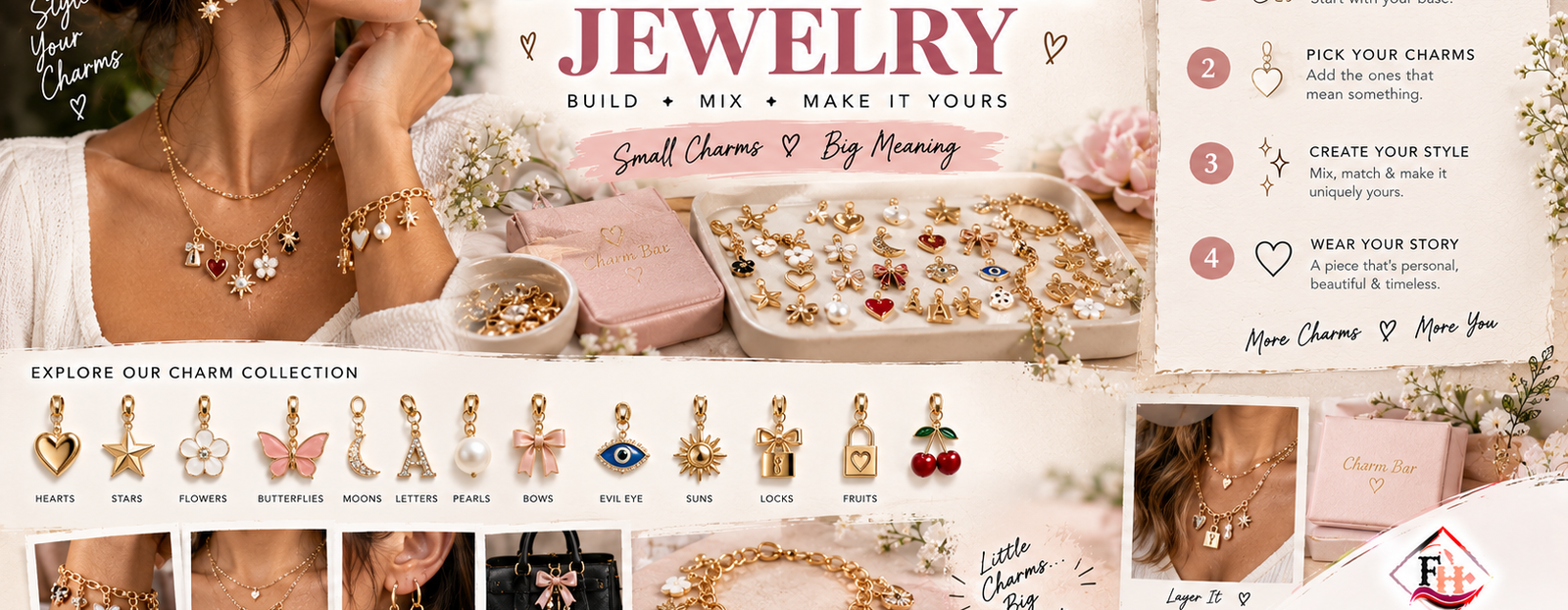
A charm bar turns jewelry shopping into a build-your-own project you pick a chain or bracelet, then choose individual charms and have them attached. It’s more personal than buying a finished piece, but it’s also easy to overspend, overcrowd, or end up with a chain that sags under its own charms. This guide explains how a charm bar jewelry works, how to choose the base, attachment, metal, and charms, the arrangement and layering rules that keep it looking intentional, and the mistakes to avoid.
What Is a Charm Bar jewelry?
A charm bar jewelry is a store, pop-up, party format, or online builder where you assemble a piece of jewelry from separate parts: a base (necklace chain, bracelet, anklet), a method of attaching charms, and a selection of charms. Instead of buying a pre-made piece, you choose each element, which makes the result more personal and lets you add to it over time. At some charm bars jewelry, staff attach the charms for you with jump rings and tools, while online versions may let you clip them on yourself.
How to Build Your Piece Six Steps
1. Choose the Base
Pick the base first, since everything else depends on it. A slightly sturdier chain, such as a cable or curb link, holds multiple charms without twisting or sagging, while a very fine chain suits one small charm bar jewelry. A personalized nameplate or bar necklace can also work as the base, with charms added to it over time.
2. Choose the Attachment
| Attachment | How It Works | Pros | Cons |
|---|---|---|---|
| Closed chain with jump rings | Charms are attached directly to the chain | Classic look, charms stay put | Harder to rearrange later |
| Carabiner or modular clasp | Charms hang from a clasp you can open | Easy to swap and rearrange | Slightly bulkier |
| Lobster clasp charms | Each charm clips onto a ring or chain | Simple for bracelets and bag-style builds | Clasps need occasional checking |
If you like to change your look, a carabiner or clasp gives you flexibility. If you want a settled piece, jump rings give a cleaner finish.
3. Choose the Metal
Common options are sterling silver, gold-filled, gold-plated, and stainless steel with a plated finish. Some sellers promote stainless steel with PVD plating as more durable and tarnish-resistant than flash plating, but that’s a seller’s claim, so ask what the finish is and how it’s guaranteed. If you want something that handles water and daily wear, our look at Atolea’s waterproof stainless steel jewelry explains how that kind of plated steel is positioned. Mixing metals is also a recognized modern approach, such as sterling silver with rose and yellow gold on one bracelet.
4. Choose the Charms
Start with the symbol, not the trend. Common categories are initials, birthstones, symbols and zodiac signs, hobbies, travel and places, family, and seasonal motifs. A useful rule is to choose a symbol that means something to you today, rather than whatever’s popular.
5. Plan the Weight and Fit
Every charm adds weight and can make a bracelet feel tighter. If you plan to build to eight or ten charms, start with a bracelet at the looser end of your size. A standard seven-inch bracelet can look cluttered with more than about ten charms.
6. Arrange With a Plan
See the rules below.
Arrangement Rules That Make It Look Chosen
- Use an odd number. Three or five charms read as more deliberately collected than an even number.
- Cluster toward the center-front of a necklace instead of spacing charms evenly end to end. Evenly spaced charms can look like a kit, while clustered charms look selected.
- Mix scale. Two or three charms of noticeably different sizes look composed, while five identical medallions look like inventory.
- Place the largest charm in the center on a closed chain. On a carabiner, put the largest at the back and the smallest in front so small charms aren’t hidden.
- Buy for three, wear two. Choose a set you can build up to, but wear fewer at first so you can see what balances.
- Start with one anchor. A single meaningful charm gives the piece a focal point.
Layering Charm Necklaces Without Tangles
- Layer one (shortest, about 14 to 16 inches): A thin chain or a very small charm.
- Layer two (about 18 inches): Your main charm necklace.
- Layer three (about 20 to 22 inches): A longer chain with a larger or heavier pendant.
- Leave at least two inches between chains so charms don’t clash or tangle.
- Keep the metals consistent unless you’re deliberately mixing, and keep the rest of your charm bar jewelry simple.
A single charm on a 16 to 18 inch chain is the most versatile starting point. For layered pieces without a charm focus, our guide to necklace styling explains the “let one piece lead” approach that works well here.
Charm Bracelets and Stacks
A bracelet is seen up close, so a few well-chosen charms read better than many. A balanced starter stack, according to one trend guide, is one charm bracelet, one pair of small hoops, and one slim necklace. If you’re interested in the best-known charm bracelet system, our overview of Pandora bracelets covers how that approach works. Match the metals in your stack to your earrings too; our guide to diamond earrings helps with that.
Eight Charm Looks to Try
- One initial charm on a thin chain for every day.
- A birthstone charm and a small hoop as a quiet daily stack.
- Three charms in different sizes on a chunky link chain for a bolder, maximalist look.
- A single symbol on a snake chain for quiet luxury.
- A bracelet with three charms over a white tee.
- Charm necklace over a crewneck, short and simple, letting the bracelet lead.
- A mixed-metal stack of silver, rose, and yellow gold.
- A matching bag charm and necklace for a coordinated look our guide to bag charms covers the bag side of the trend.
Choosing by Budget
Retail guides place single-charm bar jewelry pieces under about $25, personalized or chunkier pieces roughly $30 to $55, and anchor pieces like engraved necklaces at $85 and above. These come from one retailer’s ranges, so treat them as rough guidance, and compare metal, finish, and return policies, not just price.
Caring for Charm Jewelry
- Store pieces separately so chains don’t tangle and charms don’t scratch each other.
- Remove them for swimming, showering, and workouts, unless the seller specifically guarantees water resistance.
- Wipe with a soft cloth after wearing to remove oils and lotion.
- Check jump rings and clasps regularly, especially if you wear heavy charms bar jewelry daily.
- Keep sterling silver in an anti-tarnish pouch when not in use.
Gifting Tips
A charm bar jewelry piece is easy to give because it can start small. Choose a base chain or bracelet and one meaningful charm, such as an initial or birthstone, and let the recipient add more over time. Ask about the return or exchange policy in case the length or style isn’t right.
Common Mistakes
- Choosing a chain that’s too fine for the charms, so it twists or sags.
- Too many identical charms, which looks cluttered.
- Ignoring weight on bracelets and necklaces.
- Mixing metals by accident instead of deliberately.
- Layering chains too close together, which tangles charms.
- Buying a pre-picked set instead of choosing your own symbols.
Final Thoughts
A charm bar jewelry works best when you treat it as a slow project: pick a sturdy base, choose the attachment that suits how often you’ll change things, start with one meaningful charm, and add more in small groups of different sizes. Keep the metals consistent, leave space between layers, and let the piece grow with you rather than finishing it all at once.
FAQ
What is a charm bar?
A charm bar jewelry is a store, event, or online builder where you choose a base chain or bracelet, an attachment method, and individual charms to assemble a custom piece of jewelry.
How many charms should I put on a necklace or bracelet?
Three is a good starting point. A necklace usually looks best with a small cluster of two to six charms, and a standard bracelet can look cluttered with more than about ten.
How do I layer charm necklaces without tangling?
Space chains at least two inches apart, such as 16-inch, 18-inch, and 20-inch lengths, and keep the heavier or larger pendant on the longest chain.
What’s the difference between jump rings and a carabiner clasp?
Jump rings attach charms permanently for a cleaner look, while a carabiner or modular clasp lets you swap and rearrange charms easily.